Twenty years ago, the idea of creating sculptures and works of art using robots and 3D scanning was considered almost sacrilegious—an affront to a tradition of craftsmanship and physical labour regarded as untouchable, yet one that, even then, was already struggling to attract younger generations.
Two decades later, the company that was among the first to embrace technology applied to stone—benefiting from its location in Carrara, the heart of the world-renowned marble district—is now listed on Euronext Growth Milan, the stock market dedicated to SMEs, and is looking to expand precisely through high-tech applications and robotics.
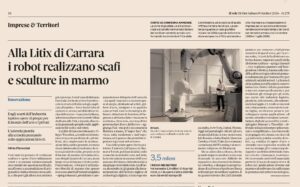
Litix, founded by Giacomo Massari and Filippo Tincolini, reported revenues of €4.6 million in 2023, with EBITDA of €1.28 million. The company is currently completing its new headquarters, comprising a sculpture workshop and eight robotic stations, directly beneath the Fantiscritti marble basin, one of Carrara’s most famous quarries, in a location steeped in the history and heritage of marble extraction.
“We often use blocks of marble that would not normally be suitable for the stone industry,” explains Massari, the company’s Chairman and CEO. “Yet we are able to transform them into valuable works destined for artists, art galleries, designers and, in some cases, private collectors. Technology has lowered the barriers to entry and helped bring sculpture back to life.”
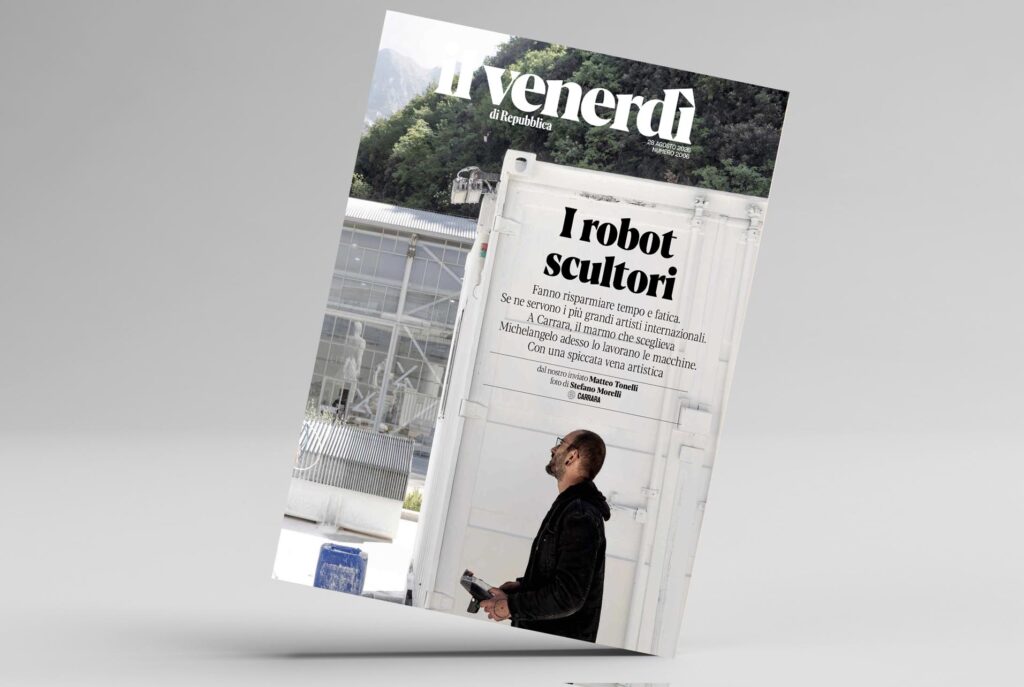
But there is more. “Machines can carry out 90% of the work,” the CEO adds, “but the final hand-finishing is still essential—the craftsmanship that comes from tradition and experience. And this is precisely what could bring young people back into the industry.”
One of the first projects to bring the company—then known as Torart, before later merging into Litix—to international attention was the 2016 reconstruction in marble of the Roman Arch of Palmyra, destroyed in Syria by ISIS. The arch was reconstructed in 3D using documentation provided by the UK-based Institute for Digital Archaeology and was subsequently exhibited in London, New York, Dubai and Florence.
Today, Litix’s client portfolio—90% of which is international—includes names such as Jeff Koons and Zaha Hadid, Maurizio Cattelan and Fabio Viale, as well as the Carmelite monks of Wyoming and the Mormon religious community.
Alongside sculpture, which enjoys significant media visibility but operates in a market where demand is difficult to scale, Litix’s robotics division is expanding, together with the development of software and hardware technologies originally created for stone processing.
This is the area on which Litix intends to build its future growth.
“In the first half of this year, for the first time, revenues from the robotics division exceeded those generated by the sculpture division,” Massari explains. “We now want to focus on robotic integration, adapting existing technologies—typically developed for the automotive industry—to the needs of other sectors. Our stock-market listing gives us the momentum to enter new industries.”
Litix robots are targeting markets such as the marine industry, where they can be used to manufacture moulds for boat hulls, as well as the stone, plastics and cement industries and recycling applications.
The €2.2 million raised through the company’s listing last July will be used specifically to develop new applications.
“Our goal is to make digital manufacturing accessible to everyone,” Massari and Tincolini explain, “by offering increasingly advanced yet easy-to-use solutions.”
For the six months ending 30 June, Litix reported revenues of €3.5 million: €1.9 million from robot sales, €1.4 million from the sale of artworks, and €260,000 from 3D printing and computing/design services. EBITDA stood at €600,000.
Growth is expected to remain strong. In the second half of the year, Litix plans to launch mini robots, robotic systems for applications beyond marble, and new software solutions designed to further strengthen its position in the technology sector.
Silvia Pieraccini